I have been thinking about this a lot lately. Not in a lecture-y way, not as a yoga teacher wagging her finger at people about their screen time. I have been thinking about it because I see it everywhere and I feel it in myself too. This pull toward the phone. This habit of reaching for it the second there is a gap. The second you are alone. The second there is nothing to do. And I am starting to wonder what it is doing to us.
I was at Burning Man this year. If you have never been, it is a week in the desert where you live without most of the things the regular world runs on. No commerce, no schedules, no obligations. And for me, no phone. I stuff it away. I look at it once a day in my sleeping quarters to make sure nothing urgent has happened with my kids or the studio. Other than that, the present moment is everything. I have no plan, no timeline, and living that way is like a yearly reset.
To me Burning Man has always been a place where people are intentional about presence. Which means putting phones away and being curious about the moment. Showing real interest in who is in front of you, not what their roles or titles are. It feels like a constant invitation to open up to what is happening right now. People are so generous in creativity and kindness and sharing whatever they have. To me, it always restores my faith in humanity.
But this year I also experienced something else. And it felt like a sickness that is spreading. This year more than ever, I saw people living through their phones. Not being in the moment but making content about the moment. Filming instead of feeling. And it felt like a tick, something toxic that slowly spreads through a body and creates pain and discomfort everywhere it reaches. It felt like there were two worlds colliding, one of deep intentionality and this creeping disease of disconnection. And it really shook me, asking myself; where do we go from here?

Over the summer I was at a beautiful resort in Jamaica. This couple had paid for this incredibly romantic canopy dinner on the beach. It looked stunning. White fabric, lights, the ocean right there. Every time I looked over, both of them were on their phones, the entire dinner.
And I do not think that is uncommon anymore. I see it everywhere. Couples on their phones during dinner. Friends sitting/walking together with phones out. It somehow seems OK now to be in the middle of a conversation and look down to check something on a screen. Like the person across from you is less interesting than whatever just buzzed in your pocket.
I see it waiting for transport, waiting in line, sitting at a restaurant. The moment people are alone, the phone comes out. As if 30 seconds alone with your own thoughts is too much.
I want to be clear about that. I catch myself scrolling too. I reach for my phone when I do not need to. I know the pull. It is not like I have figured this out and now I am going to tell everyone else what to do. I am in it with you.
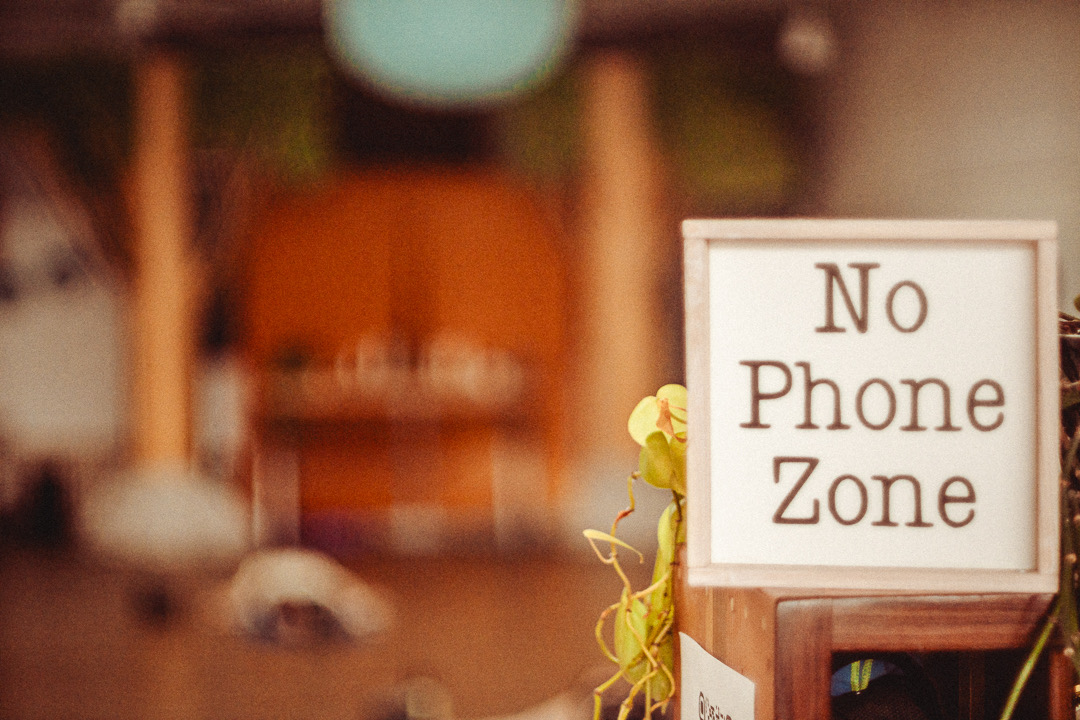
At Home Studio Yoga in San Anselmo we have a sign when you walk into the practice space that says No Phone Zone. And people generally stick to it. But I also see people reach for their phones immediately when class is done. Including myself sometimes. Like we can only be present for the length of the class and then the habit takes back over.
There is a Buddhist concept called sati. It is usually translated as mindfulness but it literally means remembering. Remembering to come back. Remembering that you are actually here. The phone is the opposite of sati. It is forgetting. You forget you are at dinner. You forget you are at the beach. You forget the person sitting across from you is right there.
Here is the part that really bothers me. It is not just that we are distracted. It is that we have become spectators in our own lives.
There is this whole culture now of filming everything, creating content about your experience instead of having the experience. And it has created this world where people have to do extreme things or look a certain way or follow a trend to get noticed. And it is so confusing to me. Because what is real? Is this person having a beautiful moment, or are they performing a beautiful moment for their phone? Are they at the concert, or are they holding up a screen at the concert? Are they on vacation, or are they creating evidence of a vacation?
In yoga philosophy there is a concept called pratyahara. It is the practice of withdrawing your senses from external stimulation and coming back to yourself. But here is what I keep thinking about: we are practicing doing pratyahara: we are withdrawing from the world around us. However, we are withdrawing in the wrong direction. Instead of coming inward and closer to the Self, we are disappearing into a screen, into something outside of us. And we have accidentally mastered that practice.
And I think the cost of that is higher than we realize. Because when you are always watching, or filming, or creating content, you stop participating. You are not in your body anymore. You are not making eye contact. You miss the awkward, unfiltered experience of just being a human in a room with other humans.
I have deliberately chosen to give my kids a screen free childhood. That is a whole topic on its own and I am not going to pretend it is easy. But I made that choice because I can see what screens do to adults who have fully developed brains and coping mechanisms. And I think about what it is doing to kids who do not have those things yet.
I do not want my children to grow up thinking that the point of an experience is to film it so they can show others. I want them to know what it feels like to be bored, to be present, to be uncomfortable with nothing to do and then discover what happens when you just sit with that.
I think this is part of why I built the studio the way I did. It is one of the few places left where people actually put their phones away and show up. Where you are in a room with other humans, breathing together, not performing anything. No cameras, no mirrors. Just presence.
And it is hard. Even for an hour, being fully present is hard. Your mind wanders. You make your to-do list during pigeon pose. You think about dinner during savasana. But at least you are trying. At least you are in the room. At least your phone is not in your hand.
That No Phone Zone sign at the studio is not a rule. It is an invitation. But I put it there to remember to come back to yourself. To practice being here, being present.
I am not going to wrap this up with a nice lesson or a call to action. I honestly do not know what the answer is, I don't know where we go from here. What I do know is that I feel more alive when my phone is put away. I know that the week at Burning Man where I barely looked at a screen reminded me of who I am when I am not distracted. I know that the couple in Jamaica had everything they needed for a beautiful evening and they missed it.
And I know that every time I walk into the studio in San Anselmo and see a room full of people with their eyes closed and their phones somewhere else, I think: this is it. This is what we are losing and this is how we get it back. One hour, one practice at a time.
With love,
Martine
How do phones affect our ability to be present?
They train us to leave the moment we are in. Every notification pulls your attention out of the room you are actually standing in. Over time it becomes a reflex. The second there is a gap, a pause, a moment of stillness, the hand reaches for the phone. We lose the ability to just be somewhere without also being somewhere else.
What is pratyahara in yoga?
Pratyahara is the yogic practice of withdrawing your senses from external distractions and coming back to yourself. It is one of the eight limbs of yoga. The irony is that we are already practicing a version of it constantly, just in the wrong direction. We withdraw from the real world and disappear into a screen instead of coming inward.
How can I be more present in daily life?
Start small. Put your phone in another room during dinner. Leave it in the car when you walk into the studio. Notice how it feels to stand in line without checking anything. It will be uncomfortable at first. That discomfort is the practice.
