I am going to be honest about how I felt the first time I did restorative yoga. I thought it was not for me.
I live a fast paced life. Which is kind of funny to say as a yoga teacher who also meditates. But when I did restorative for the first time, all I could think was that I wanted to move more. I should be getting more out of this. More poses, more burn in my muscles, more exertion. Lying still on a bolster for ten minutes felt like I was wasting time when I could be doing something that would actually make me sweat.
That was before I became a mom.
After my kids were born something shifted. I could feel in my body that the constant pushing was not sustainable. I can always do more. There is always more to do. But when do we actually take the time to do less and soften? That is when restorative started to make sense to me. I went from thinking it was not enough to realizing it might be the thing I needed most.
If you have never done restorative yoga it is sometimes hard to explain. You practice yoga for an hour and fifteen minutes and you only do four to six poses. That is it. Four to six.
Each pose is held for somewhere between three and ten minutes. Sometimes a pose has a left and right side, so you do both. But the point is not to stretch harder or go deeper. The point is to let go. To let your body actually restore.
You are completely supported by props the entire time. Bolsters, blankets, blocks, sometimes even chairs. Whatever is needed to help you be comfortable and to soften into the pose without effort. The teacher lets you know what props you need and will come around and help you if something does not feel right. They might slide a block under your knee or add a blanket under your head or gently reposition you so you can actually relax.
The lights are dim, the atmosphere is calm and soothing and your only job is to receive.

Most of us spend our days giving. Our time, our energy, our attention, our care. To our jobs, our families, our friends, our phones. We are giving all day long. And then when someone offers us something as simple as lying still and being supported while a teacher takes care of us, there is this resistance. Like we have not earned it yet. Like we should be doing more first.
Restorative yoga asks you to just receive. To be held. To let the props do the work. To stop trying so hard. And for a lot of people that is the most uncomfortable part of the entire class. Not the poses or the stillness, but the receiving.
I know because that is exactly what happened to me. And then slowly, over time, I started to actually love it. The softening became the thing I looked forward to most. The quality of slowing down and receiving became crucial to my well-being in a way I did not expect.
There is real science behind why restorative yoga works the way it does.
A 2024 systematic review published in Frontiers in Psychiatry found that yoga significantly reduces cortisol, which is the body's primary stress hormone. But here is the part that matters for restorative specifically: the study noted that intense exercise actually raises stress hormone levels, while slower practices lower them. So if you are someone who is already stressed and dealing with burnout and you keep pushing yourself through intense workouts, you might actually be adding to your stress load without realizing it.
That tracks with what I see at the studio. People come in wound up and running on fumes. They think they need a hard class to burn it off. And sometimes they do. But sometimes what they actually need is to stop.
When you are in a restorative pose for five or ten minutes, fully supported, your nervous system gets the signal that it is safe to stand down. Your heart rate drops. Your breathing slows. Your muscles release tension they have been holding for who knows how long. This is just your body doing what it does when you finally stop long enough to let it.
People ask this a lot. They are both slow. They both involve holding poses for a longer time. But they feel quite different.
In yin yoga you are working into the connective tissue. You hold poses for several minutes and there is often real sensation, sometimes even discomfort. Yin is asking you to sit with that sensation and breathe through it. It is a quieter practice but it is not necessarily a restful one.
Restorative yoga is different. You are not working into anything. You are not stretching to your edge. You are being completely supported so that your body can let go without any effort at all. If you feel strain in a restorative pose, something needs to be adjusted. The props are there to make sure you feel held, not challenged.
The simplest way I can put it: yin asks you to sit with discomfort. Restorative asks you to let comfort in.
Suzanne Wright comes one to two times a week and calls it the highlight of her week. In her own words: "I leave feeling positive effects both physically and mentally. I'm energized in a calm way, relaxed and balanced. I've done restorative yoga at other studios but have found my all time favorite."
That "energized in a calm way" is the part that catches people off guard. You would think lying still for an hour would make you sleepy. But what actually happens is you feel restored. You just feel genuinely good in your body.
Janet Jacobs described it as connecting her back to herself and her body. And Anjali Sawhney, who has decades of yoga experience, still learned two new poses in Veronica's class. So it really is for everyone, whether you are brand new or you have been practicing for years.
Restorative yoga is for everyone. But I would say it is particularly for the busy bees. The people who are always doing. Always giving. Always on. If that is you, I want you to know something: the discomfort you might feel lying in a pose for ten minutes without doing anything is part of the practice. It might feel weird. You might doubt you are doing it right. Because are we not supposed to do more?
But that discomfort of slowing down is what makes restorative so valuable. And over time, you stop resisting it and you start loving it. That is what happened for me. I went from this is not for me, to, wow, we need more of this.
Strength training is such a trend right now. Everyone is working with weights, building muscle, pushing harder. And I think that is great. But when we push, we also need to balance it with the calm, the rest, the softening. We can not just push push push. We all need this. It is truly a gift we give ourselves.
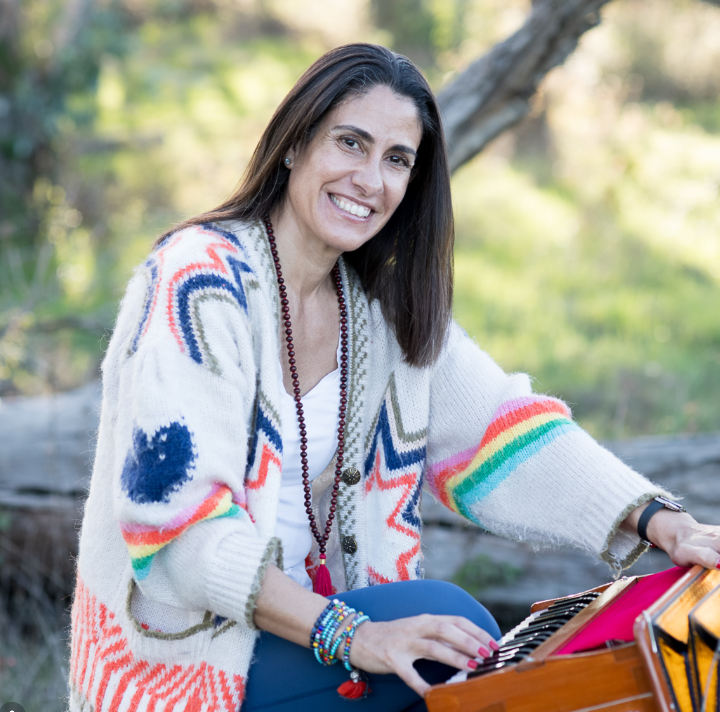
At Home Studio Yoga in San Anselmo we offer restorative yoga every Tuesday evening at 7:15pm. Veronica Plasencia teaches every session and she is exactly the kind of teacher you want for this. People say about her that she is nurturing, calm and supportive. And that is true. She will help you set up your props, adjust your positioning, and make sure you feel completely held.
If you are a beginner, Tuesday night is a really beautiful place to start. And if you have tried restorative somewhere else and it did not click, I would still say come try it with Veronica. The teacher and the space matter a lot. And Veronica is really good at this.
You can see our schedule and book your first class at homestudio.yoga/our-schedule.
With love,
Martine
What is restorative yoga?
Restorative yoga is a slow, gentle practice where you hold four to six poses for three to ten minutes each, fully supported by props like bolsters, blankets, and blocks. The goal is not to stretch or strengthen but to allow your body and nervous system to deeply rest and restore.
Is restorative yoga good for anxiety and stress?
Yes. Research shows that slow yoga practices reduce cortisol levels and activate the parasympathetic nervous system, which is your body's rest and repair mode. Restorative yoga is particularly effective for people dealing with chronic stress, burnout, and anxiety because it gives your nervous system the signal that it is safe to stand down.
What is the difference between restorative yoga and yin yoga?
In yin yoga you hold poses and work into connective tissue, which can involve real sensation and discomfort. In restorative yoga you are completely supported by props so that your body can release without any effort. Yin asks you to sit with discomfort. Restorative asks you to let comfort in.
Do I need experience to try restorative yoga?
No. Restorative yoga is one of the most accessible forms of yoga there is. There are no complicated poses and you do not need any strength or flexibility. The teacher will help you set up your props and make adjustments so you are completely comfortable.
Is restorative yoga a good workout?
It depends on what you mean by good. If you mean will you sweat and feel your muscles burn, no. But if you mean will your body get something it deeply needs, absolutely. Restorative yoga works on your nervous system in ways that intense exercise cannot. It is the balance to all the pushing we do. And most people walk out feeling better than they have in weeks.
Where can I do restorative yoga in San Anselmo?
Home Studio Yoga offers restorative yoga every Tuesday evening at 7:15pm at 135 Tunstead Ave in San Anselmo. Veronica Plasencia teaches every session. You can book at homestudio.yoga/our-schedule.
Where can I do restorative yoga in Marin County?
Home Studio Yoga in San Anselmo offers restorative yoga every Tuesday at 7:15pm. We are located at 135 Tunstead Ave, right in the heart of Marin County. You can see our full schedule and book your first class at homestudio.yoga/our-schedule.
