I am going to be honest about how I came to Yoga Nidra. I did not come to it because I was spiritually curious or because someone told me it would change my life. I came to it because we were going to offer it at the studio and I needed to understand what it was well enough to explain it to other people.
That was it. That was my only reason.
I remember my resistance clearly. I am a busy mom, I do not have a lot of time, and when I do have time I want to make sure I am using it. Moving my body, meeting someone, getting something done. It is the producing mindset. I need to produce something for the time investment to feel worth it. Lying on the floor for 45 minutes doing nothing felt like the opposite of that.
And then I did it. And I was sold. Completely.
I told my mom friends afterwards: this is exactly what we need. We do not need something to push us more. We have our kids, work, social circles, the household, our families, societal expectations already doing that for us. What we actually need is a moment of uninterrupted time where someone guides us to really soften and let go.
I walked away feeling like I had had a good night of sleep. Not the broken kind I have grown used to as a mom. An actual good one.
Yoga Nidra is sometimes called yogic sleep, but that is a little misleading because you are not actually sleeping. You are lying in savasana, completely still, while a teacher gently guides you through layers of relaxation. Breath awareness, body scanning, visualization, sound. You are somewhere between awake and asleep. Not quite either.
At our studio in San Anselmo Nimisha Gandhi leads Yoga Nidra and she is really good at what she does. She does not just tell you to relax and then leave you there. She talks you through the entire session, guiding you deeper as you go. She finishes with a sound healing and by that point the whole room is just gone. In the best way.
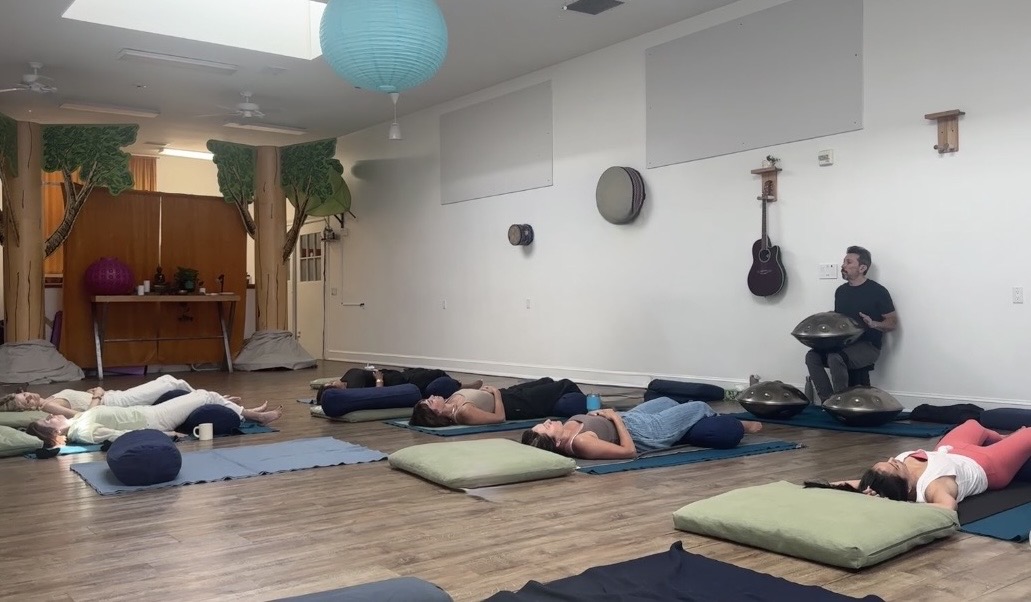
For people who have experienced Yoga Nidra before, they walk in already grateful that we offer it. They know what is coming. For newbies there is usually some uncertainty. How do I set up. What props do I use. Where do I put my arms. Nimisha helps with all of that. We have big green pillows, blankets, bolsters, and she will literally help you make your "bed" before the session starts so you can actually let go.
This question comes up a lot. All three involve slowing down but they feel quite different in the room.
In restorative yoga you are in supported poses, held by props, but you are still in shapes. You might be in a supported bridge or a reclined twist. Your body is doing something, just gently.
Yin yoga holds poses for a longer time and works into the connective tissue. It can be intense in its own quiet way. There is sensation and sometimes real discomfort as you sit with a stretch for several minutes.
Yoga Nidra is none of that. You lie flat on your back and you do not move. There are no poses. There is no stretch. There is no effort. The only thing you are doing is following the teacher's voice and letting your body get heavy. It sounds like nothing. And in a way it is nothing. But nothing turns out to be surprisingly hard to do.
We live in a culture that rewards doing. Producing. Moving. Optimizing. Even our rest has become productive somehow. People talk about sleep hacking and recovery protocols and making sure their downtime is maximizing something.
Yoga Nidra asks you to just stop. For 45 minutes. No goals, no outcomes, nothing to optimize. Just you lying on the floor with your eyes closed while someone guides you into a state of deep rest.
For a lot of people that is genuinely uncomfortable at first. The first five minutes your brain is making lists. Your body wants to fidget. You are wondering if you are doing it right. You might feel guilty for not doing something more useful with your time. I know because that is exactly what happened to me.
But somewhere around the ten minute mark something starts to shift. Your body gets heavier. Your thoughts start to blur a little. You are not asleep but you are not really awake either.
I kinda wander off without really falling asleep. This heaviness takes over and I feel my body softening and letting go more and more. And when it is done I feel like I got a genuinely good nap in. As a mom that is gold.
This is not just a feeling. There is real science behind what is happening in the room.
A 2026 meta-analysis published in the Annals of the New York Academy of Sciences reviewed 73 studies with over 5,200 participants and found that Yoga Nidra significantly reduces stress, anxiety, and depression. That is not a small study. That is a lot of data pointing in the same direction.
A 2025 randomized controlled trial found that even just 11 minutes of daily Yoga Nidra practice measurably reduced cortisol, which is the body's main stress hormone. It also improved sleep quality and reduced the tendency to ruminate on negative thoughts. That tracks with what I experience every time. The mental chatter just quiets down.
During Yoga Nidra your brain shifts into delta and theta brainwave states. These are the same states your body enters during the deepest stages of sleep, the ones linked to cellular repair and restoration. So you are getting that level of recovery while you are still conscious. Which is kind of wild when you think about it.
Honestly anyone who is tired. But especially people who are running on empty and do not know how to stop. Moms. Caregivers. People dealing with anxiety or insomnia. People who have tried meditation and could not get their brain to shut up. People who feel like they are always behind.
You do not need any yoga experience. You do not need to be flexible or know any poses. You literally just need to be able to lie down.
If you cannot remember the last time you actually felt rested, come try this.
We offer Yoga Nidra once a month at Home Studio Yoga in San Anselmo, on the last Wednesday of every month. Nimisha Gandhi leads every session and she has decades of experience in Yoga Nidra, energy medicine, breathwork, and Ayurveda.
You can check our upcoming schedule at homestudio.yoga/our-schedule.
With love,
Martine
What is Yoga Nidra in simple terms?
Yoga Nidra is a guided deep relaxation practice where you lie down and follow the teacher's voice into a state between waking and sleeping. You do not move. You do not do any poses. You just rest while your teacher guides you through layers of relaxation.
Is Yoga Nidra the same as meditation?
Not exactly. Meditation usually involves sitting upright and focusing your attention on something. Yoga Nidra is practiced lying down and the teacher does most of the guiding for you. It is less about concentration and more about letting go completely.
Can I do Yoga Nidra if I have never done yoga before?
Yes. There are no poses, no flexibility required, no experience needed. If you can lie on your back you can do Yoga Nidra. Nimisha will help you set up with props and pillows before the session so you are completely comfortable.
What if I fall asleep during Yoga Nidra?
It happens and it is totally fine. Your body clearly needed the rest. Over time most people learn to hover in that in-between space, which is where the deepest benefits happen. But honestly even if you sleep through the whole thing you will still walk out feeling better than when you came in.
How often should I practice Yoga Nidra?
Research suggests that even 11 minutes of daily practice can reduce stress hormones. We offer it monthly at Home Studio Yoga in San Anselmo, and many of our members say that one session a month makes a real difference in how they feel.
